top of page
Dread's Edge
Gameplay Walkthrough
Project Overview
This project was created within 12 weeks with a main focus on balancing player progression using atomic values. Dread’s Edge is a retro first-person shooter taking inspiration from retro games such as Bethesda’s “Doom” and combining the combat with a parkour-style movement taking inspiration from movement shooters such as Auroch Digital’s (2024) “Warhammer 40,000: Boltgun”. The player will engage in challenging combat all while exploring a parkour paradise. As the player progresses, they must use stamina and ammo wisely to navigate the other world landscapes to unlock equipment upgrades.

Project Details
- Made in Unreal Engine 5.2.
- 12 weeks development.
- Medium-sized level.
- Solo Developer.
- Progression, the player must progress to unlock upgrades.
- Progress Tracked through Jira
- Sprint Planning & Retrospective documented on Miro.
- Linear Level
Level Design
References
References were crucial to allowing me to gain inspiration from other games while generating the creative direction of my level.
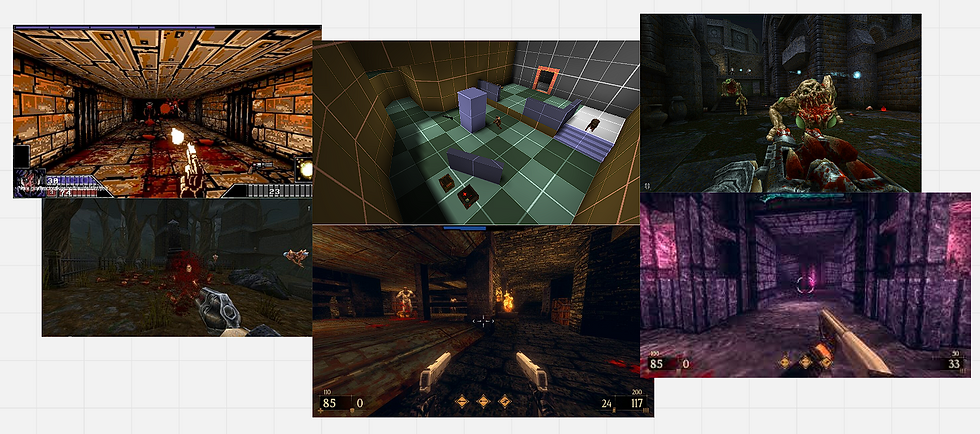
Player Flow
Outlining player flow in terms of level design was crucial before prototyping as it allowed me to gain a sense of balance. Ensuring each combat encounters were adequately balanced with exploration to create a great player experience.

Design Choices
Perspectives

Withholding information from the player invokes emotions such as anger. Presenting the player with a new perspective and new information releases the anger by providing a solution to their problem. This is repeated in different contexts throughout the level keeping gameplay scenarios interesting.
Branching Pathways
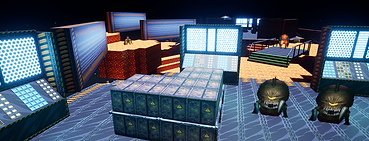
Using branching pathways presents the illustration of choice to the player, tailoring to different player styles. Although the level is linear, presenting branching pathways increases replayability and provides the player with choice. Some players may like to use the parkour abilities to manoeuvre whereas other before run and gunning.
Defined Affordances
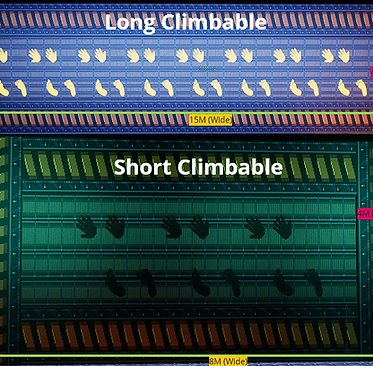
Defined affordances have been implemented to allow the player to distinguish climbable aspects of the environment. This was a major design problem I encountered, making a retro-shooter, players don't expect to be able to wall run. Therefore, by creating consistencies with climbable surfaces such as the hand prints, height, width, and visual effects it allows players to identify climbable surfaces without the need of tutorialisation. To contrast with affordance-denying background I also added a border zone as part of the design language for climbables.
Buffering Metrics
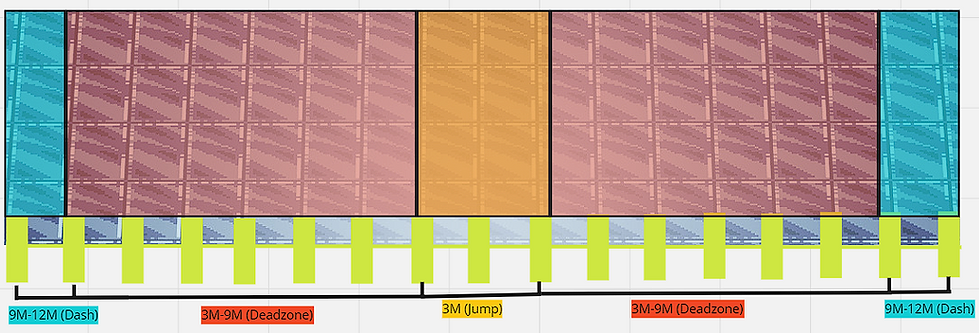
Developing consistencies with pitfalls was crucial to ensure the player could predict whether a gap could be jumped across or if it required a more advanced approach, such as a double jump, or dash. This is supported by playtest data from the final iteration (Build V.4), which states “It's not overly powerful to jump over enemies and skip areas and was the perfect amount of height to progress through areas with elevation”.
Player Progression
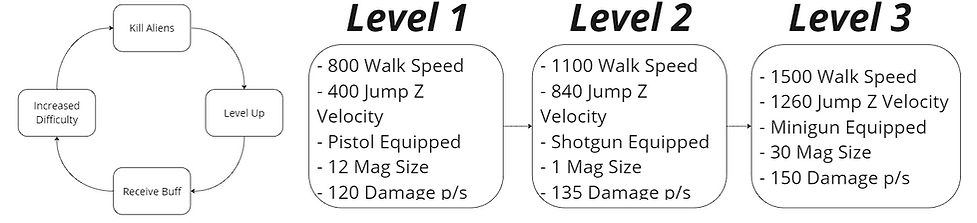
At a basic level, the diagrams above showcase the player progression within Dread's Edge. To give a basic description, the player kills enemies to level up which provides them with an equipment upgrade. This upgrade increases movement stats and provides them with a new weapon that deals more damage.
Atomics
Progression Documentation
Supporting Documentation
Playtesting Diary
Bug Tracker
bottom of page